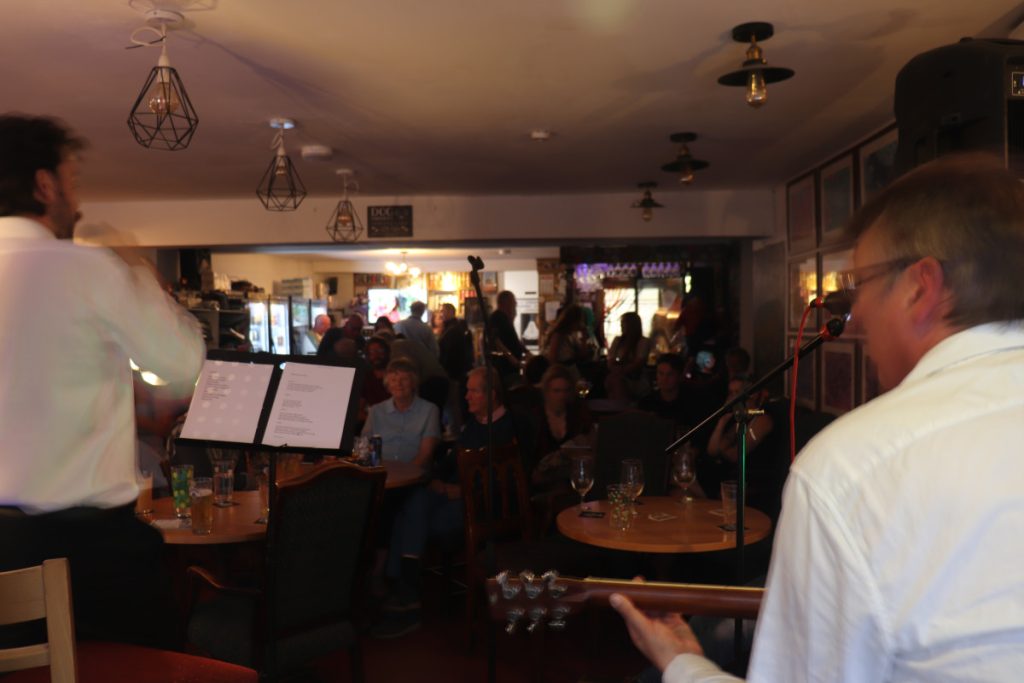
Whew. That was a blast. Those five days were a bit of a blur, but just when I thought I’d recovered from that, it was time to do reviewing at Edinburgh Fringe. (If you want to know about that, you can read the coverage on my theatre blog. Short version it that is was eight days and 39 shows out of the 320 review requests.) And then I decided it was a good idea to go on holiday the week after - and those who know me will be aware my holidays are even bigger endurance tests. But, at the time of writing this paragraph, I have just completed a 20-mile lap of Paris, and I thought I've make a start.
This is on my own web page because these are my own personal view. Nothing I’m going to say here is in conflict with agreed Durham Free Fringe ethos (we’re a team, no one person dictates things), but the focus here is a lot more on why I’m doing it and what it was like for me.
The prologue
I’ve been on the fringe scene in Durham since Durham Fringe began in 2021. I’d said for years that the north-east needs a fringe, so that local acts get a fair chance to showcase themselves. Having been active on the fringe circuit elsewhere, and having also been active in Durham Dramatic Society who run the City Theatre, I wanted to do my bit to make this succeed. Between 2021 and 2023, I effectively ran the City Theatre Durham Dramatic Society's behalf (apart from programming, ticketing and front of house which Durham Fringe took care of). I was proud of the role I played in making the City Theatre a viable venue, and I'm still proud of it.
As many of you will know, there was big falling out in 2024. I won't repeat the details now, suffice to say, it was 90% down to a deteriorating relationship with Durham Dramatic Society (including, amongst other things, taking the credit for my Durham Fringe work). Durham Fringe was caught in the middle, but the upshot was that it was impossible for me to carry on doing the same job. Whilst I could have moved to another role, it was at this point I'd decided the time had come for me to do my own thing completely.
A free fringe event made sense for several reasons. I knew Durham Fringe were keen on the idea but had never got round to doing it themselves. From my point of view, it was largely the same as what I’d done already, minus front of house and ticketing - both of which a Free Fringe largely does away with. But there was a more fundamental reason: as someone who struggled for years to get a look-in, my loyalty has always been with grass-roots artists seeking their first break. The north-east has historically been terrible at this; Durham Fringe is a VAST improvement in this regard, but as long a single act is denied the chance to show what they can do, the job is not done. That job, that I set out to do 2021, is the job I want to complete.
And that, folks, is the reason behind our tagline “a stage for everyone”. This well-meaning phrase was adopted by Edinburgh Fringe, and it's sort-of true there, but has the obvious barrier of expense. The Free Fringe at Edinburgh alleviates this, doing away costly labour-intensive pop-up theatre spaces: for many acts, especially stand-up comedians, all you need is an audience and some floor space (something pubs eagerly provided for free). However, Edinburgh Free Fringe doesn’t escape eye-watering travel and accommodation expenses. A Durham Free Fringe, on the other hand, could be affordable and accessible in every respect.
And so in 2025, two of us, Aadil Kurji and myself, decided to have a go at this. The Holy GrAle was his idea, and a great idea it’s turned out to be. There were two things we wanted to avoid: we didn't want to have to say "no" to any applicants, but we also wanted to avoid a fringe too large for us to manage. So we went for a low-key launch - almost too low-key in hindsight - but we managed an event with six acts and nine performances between them.
We’d done it. We’d put on an event. Not the most spectacular launch year - but it was never meant to be spectacular, only a start. Now we could take stock of where we were, prepare for a bigger push next year. Which is 2026, this year.
And then things went nuts.
This year …
Going into 2026, we went for a strategy of “elastic” capacity. We still wanted to say “yes” to everyone who applied, but still had no idea how many applications we’d get. So the idea was to plan a modest scale, but with provision to expand according to demand. Aadil and I eventually decided to launch applications with just the Holy GrAle on board, and consider approaching other venues later.
And so, we launched in January with no idea what would happen. I knew that if we were to be taken seriously, we needed a convincing advancement beyond six. But there was no flurry of applications after launch - and halfway into February … still no applications. Were we going to make any progress at all? Would we even get six? The first few started trickling in, we breathed a sigh of relief that at least we wouldn't be shrinking. But we went into March still not really breaking single figure … and then ... boom.
Suddenly, we found ourselves dealing with around 25 applications. Having thought about a face-saving plan make a smattering of acts not look too dismal, suddenly we had opposite challenge of finding enough venues to fit everyone in. By this point, Dan Husband had joined the team (having featured last year as a guest spot in a mixed bill show), and one side-effect of the publicity through his channels was a lot of spoken word uptake. Because of this, we decided to see if the Miners’ Hall would be up it, as a hub for spoken word.
I won’t tell a lie, getting extra venues on board was a challenge, with a lot of chasing up emails, retrieving lost emails from spam folders, getting details agreed with venues, and some ultra-stressful last-minute enquiries to confirm some things we'd not properly confirmed. But with the Miners Hall on board and the Market Tavern as the third venue, we got the final details sorted out with days to spare. With the last bits of programming finalised with days to spare, off we went …
... and five days later, we'd done it.
If there’s one thing I've noticed, it's that Durham Free Fringe is beginning to take a life of its own. I originally expected it to work similarly to Edinburgh Free Fringe: a open self-selecting programme, but dominated by stand-up comedy. Instead, spoken word and music have become the dominant parts of the programme. We've also deviated heavily from the Edinburgh model of stewarding audiences into spaces at the start of a show and out at end. Instead we had audiences dropping in and dropping out, from just one drink to hours of shows. Other things that evolved in their own way was strong attachment of artists and audiences to one favourite venue, and a surprise impromptu performance at the front of the Market Tavern into the Market Place.*
*: Not sure that was actually legal, but so far no-one has come to arrest me.
And to be clear: all of these changes of plan are good. I believe fringe festival are at their best when they are shaped by the performers. You could impose limits on one category in the name of a “balanced” festival (spoken word in our case, other festivals might want a limit on comedy). I think that would be a mistake. If we're short of theatre or magic acts, we won't do anybody any favours by curbing a surplus of acts in other categories. I'd much rather let our eventual line-up come as a surprise.
There is, however, one challenge which you may not appreciate: imposter syndrome. I've had this as a performer, as has pretty much all other performers: the feeling that you're not a "real" artist, and the "real" artists are the ones with more established careers than you. But it's a lot more daunting to battle imposter syndrome when you're running an event, especially when you're in the shadow of a more established and bigger event: again, the feeling that your festival isn't a "real" festival, and the "real" festival is the one you're running alongside.
However, the thing that helped me through this imposter syndrome was the support I had. Huge thanks to Aadil and Dan as co-organisers, of course - quite apart from sharing the workload, I'm not sure I could have held my nerve without. A big thank you also, though, to the numerous people inside and outside Durham who wished us luck and said they appreciate what we're doing. I realise I was mostly responded to this with a seemingly non-committal "cheers pal" but only because I was trying to not look like an over-stressed madman. I truly appreciate the support and encouragement, it gives me the motivation to press on.
But the thing that brought tears to my eyes more than anything was a packed Holy GrAle on the final night when we had our musical finale. It was thing point that made me thing: we've done it. This is more than a few stragglers cobbling together a small gathering - this is an event in its own right. And, I hope, and event people will keep coming to.
Which brings us to Durham Free Fringe 2027, which we're planning already.
What could have been done better ...
Okay, now it's time for the introspection. Though Durham Free Fringe 2026 was ultimately a success, it was messy. This probably applies to most events, but however smooth it looked on the surface, it was a lot scrappier under the hood. Our expectation is that there will be more applicants next year - and we want to continue to say "yes" to everybody - and we are going to have to get more organised. We are in early days on considering what this would be like.
In the meantime, however this list - treated as the "yes, we know" list - is a summary of the areas where I accept things could be improved:
- Should have had venues on standby earlier: In our defence, it seemed a good idea at the time to start with just the Holy GrAle. But it turns out we'd underestimated how long it takes to confirm venues we've previously not worked with. It also didn't help that we spent too long trying to enlist one venue (that I was convinced would be up for it) who never answered any of our messages. I think we're pretty much agreed that next time we'll need get more venues signed up before applications open. We can figure out coping with higher-than- or lower-than-expected demand later
- Artists offers shouldn't have been that late: The cause of this was, of course, not getting venues confirmed until late in the day. We originally said we'd try to get offers out in April, May would probably have been okay, but June was really pushing it, with some final slots not even sorted until July. Thank you to everyone for putting up with the late schedule, but you deserve more certainty.
- PA systems are not optional. The service we advertised guaranteed nothing more than a room - we said we might be able to provide extra help, but ultimately the only guarantee if the performers providing their own. However, this is not how things are working in practice. The Holy GrAle and Miners' Hall really work better with one PA system for everybody rather than everyone bringing in their own equipment - and I don't think the music acts would have managed without, even if they said they could. The good news is that we actually got inundated with offers for PA systems, but we didn't quite manage to cover all bases and a couple of acts slipped through the cracks. Sorry if that was you - we will be better organised next time.
- Too much manual admin: The admin for a 6-show fringe in 2025 was a doddle. However, organising 30 acts manually was a nightmare. We just about kept on top of communicating with all 30 applicants (apart from one act where Dan and I thought each other had made a show offer, oops, sorry), but listings were a right pain: website, brochure and various daily guides all requiring the same information in different orders. We've gotta figure out a better way of doing this. Speaking of publicity ...
- Publicity should have been created sooner: Again, this is another problem caused by venue management delaying everything, but we really should have got the brochures printed out at least a week before the free fringe started. It was great to see so many of you browsing these, but browsing in advance would have been better.
- Lack of uptake for comedy: This one I didn't see coming. I assumed this would be our dominant category based on how the Edinburgh Free Fringe venues go, but we only had six comedy listings, of which three were borderline spoken word. Will be interested to see what you think about that. Should we try harder to get a proper comedy line-up? Or does that not matter and we just go ahead with whatever we get?
- Market Tavern: This venue is the one that struggled for audiences. Apart from aforementioned audacious musician who played outside to the Market Place, the audiences never broke low single figures, including my show that performed much better at the Holy GrAle last year. I think the lesson we've learned the hard way is that much of our audience are attached to one particular venue. Holy GrAle and Miners Hall did fine because they had an existing performing arts scene. Market Tavern doesn't really, and doesn't have an easy audience to draw on. Open to suggestions for this.
- Mixed bill events: We've also not really had much update for mixed bill events, which is a bit of a disappointment because I think these events do a lot to bring a festival together. What do you think? Persist with this or give up?
- Donations: Whilst we're pleased that acts are getting some money for this, it's not as neat and tidy as Edinburgh Free Fringe. There, audiences enter a room for a specific act, leave at the end, and donate for that act. But with audiences dropping in for several shows, it's unclear who was donating for a specific act and who was donating for all of the acts that evening. Something to discuss for next year.
All of these I hope can be discussed soon with resolutions soon after. However, there's arguably a bigger challenge that we don't have control over:
The elephant in the room
Now, the more perceptive of you might have notice that whilst we frequently mention and support the work of Durham Fringe in our publicity, Durham Fringe's publicity has never mentioned us. It reads the same as if Durham Free Fringe never existed. And the circumstances in which I went from Fringe to Free Fringe weren't exactly harmonious. Based on that, you'd be forgiven for thinking there's some thinly-concealed subtext to this.
The truth, however, is a lot less dramatic. I am frequently in contact with their manager Maria Baranowska, and the main thing that's stopped us working more closely together is quite boring: we were both too busy organising our respective festivals. But we have kept each other up to date over what we're doing, and the one agreement we do have in place is that if either of us have to take action against a performer who does something bad (like racist abuse or sexual harassment), we will warn each other of this before the wrong 'un does the same with the other festival. And we have - and we welcome - performers who are involved in both festivals. Nevertheless, the two events could be working together more.
Could we work together more? I don't know. I get the impression from the grapevine that opinions of us vary substantially within Durham Fringe, but I don't know enough from the rumour-mill to know who if anyone has gripes, or what the gripes are. From my end, I hear various gripes about Durham Fringe. Now, as far as I'm concerned, that's background noise. No festival of this size is going to please all the people all the time and I can't think of a single festival of this size that doesn't have criticisms. (For my part, I still think Durham Fringe is over-dependent on volunteers, and one day this will come back to bite them - but that is a battle I don't want to pick.)
The thing I want to avoid at all costs is Durham Free Fringe becoming a magnet for people with grudges against Durham Fringe. No festival has ever succeeded by identifying itself as anti-another festival. As I see it, Durham Fringe and Durham Free Fringe are doing two different things, and neither of us are realistically in position to muscle in on the other's territory, even if we wanted to. So it benefits nobody to have an adverse relationship. Edinburgh International Festival, Edinburgh Fringe and Edinburgh Free Fringe have no trouble understanding this, and it would be better for everyone if Durham did too.
My overriding priority is doing whatever serves our acts the best. At the moment, the biggest difficulty our acts face is potential punters in Durham City in festival week who don't even know the Free Fringe exists, let alone what acts are playing. I hope that is something where we can work with Durham Fringe; I don't know if we can. But what I can say - and this is the official position of Durham Free Fringe - is that our door will always be open for working together.
What next?
I won't try to make any predictions for Durham Free Fringe 2027. I'd have never guessed how this year's Free Fringe would go this time last year, so who knows what we get next year.
There is one thing I should clearly state: I absolutely do not want to be head honcho of a large festival. I want to do whatever is needed to realise the goal of a stage for everyone. However, if demand goes up and up and up and up, we could end up in a similar situation in Durham Fringe where someone was to be in charge of a large team of people, managing them and telling them what to do. And I'm really not the person for that. I am most at home in creative projects, either on my own, or a small collaborative venture. Big top-down operations are sometimes needed, and someone's got to be at the top, but I have no interest in that being me.
Our immediate priority is to make a decision on how to organise ourselves for next year. Free Fringe 2027 will, in all probability, be too much for two people, and too big for the informal setup we've had so far. Exactly what sort of formal structure we move to and how we get to it needs to be decided - and it needs to be decided soon.
After that, we intend to have a wider meet-up to discuss how things went and what to do for next year. I propose that the focus should be on what artists think are best for them. Until now, we have closely followed the Edinburgh Free Fringe model. But Durham is not Edinburgh and now is a good time to think about what works for Edinburgh is right here. Should we try to be more like Edinburgh Free Fringe with audiences entering and leaving for set events? Or should we overhaul the donations system to work with the way our events work? Those and other things we'd love to get your views on. We originally intended to do this in late September, but that didn't happen because we're knackered. But we hope to have one soon.
And finally: all being well, we hope to start doing the odd year-round event. These will probably be fundraising events, and rely heavily on acts we had before, but we've only just started thinking about this. Hope to have more details soon.
And finally ...
Whilst Durham Free Fringe has been a joyous week for me, it wouldn't be right to close an article about an off-shoot of Edinburgh Free Fringe without looking at the appalling events going on there. Last year, under the watch of PBH Free Fringe, one venue committed outright racial discrimination. I can say this because the artist who kicked out because of his ethnicity took the venue to court and won. There is another case ongoing at another PBH Free Fringe venue, but their excuses if anything were even worse and they'll probably lose in court too. So two venues committing discrimination - and so far not a word of disapproval from PBH Free Fringe, let alone action.
I have a bit of sympathy with PBH Free Fringe here. Unlike the paid venues in Edinburgh Fringe, the Free Fringe have very little power over the venues, who still run and staff the venues and have the same power over visiting artists that a pub has the rest of the year. Should one of them decide equality law doesn't apply to them, PBH Free Fringe cannot overrule them - and protesting too strongly jeopardises the remaining acts. PBH Free Fringe could have chosen to do without these two venues this year, but they were two pretty high-profile venues. Could I trust myself to hold firm if, God forbid, one of our venues did that?
But, at the end of the day, I really think there is no justification for any course of action other than cutting ties with venues that behave that disgracefully. Thankfully, I am confident none of the venues we are working with would pull that stunt, so hopefully we'll never be in this horrible situation. But I am strongly of the view that when it comes to serious matters like bullying, discrimination, and sexual harassment, nobody should be indispensable. It doesn't matter how valuable a venue or an artist becomes to us - as soon as someone thinks they can get away with things because they're untouchable, we are part of the problem if we don't say no.
This is just my view - it is possible that the rest of Durham Free Fringe would decide it's not worth picking that sort of fight. If I get outvoted, so be it. But that is what I want. If it comes to the choice of doing the right thing and taking a stand, or doing the easy thing and keeping your head down, give me the right thing any day.
Hopefully we will (I sincerely hope) never be put to that test. Whilst at least one free fringe chain in Edinburgh faces questions over how welcoming or inclusive they truly are, this year we were as welcoming and inclusive as can be. It was a bitter blow to see a fringe venue I'd run from the outset taken off my hands that way, but I'm proud of the team and community we've rebuilt. So this is a goodbye to Durham Free Fringe 2026, and I look forward to what 2027 brings us.
I'll be updating both my website and Durham Free Fringe's site with all the things that happened this year. But for now, this is your update.